




After billions evaporated in ETF outflows and launchpad tokens disappointed retail investors, a growing wave of founders is choosing control over convenience — and reshaping how Web3 raises capital.
Table of Contents
Introduction: The Launchpad’s Broken Promise
Something is breaking in the world of crypto fundraising. For years, token launchpads were positioned as the indispensable on-ramp for blockchain projects — the curated gatekeepers that vetted ideas, pooled retail capital, and guaranteed exchange listings. Founders queued for months to earn a spot. Retail investors staked platform tokens for the privilege of participating. It felt like order in a chaotic market.
That order is now fracturing. Across the crypto industry in mid-2026, an unmistakable trend is emerging: experienced token founders are ditching launchpads entirely, opting instead for self-hosted sales, direct community raises, and founder-controlled distribution models. The reasons are structural, financial, and deeply personal.
$3B +
confidence in 2025–26
Bitcoin ETF outflows shaking institutional
$6.2B
at 19.6% CAGR
Projected launchpad market size by 2033
100 +
alone — and rising
Token launches expected in H2 2025
Why Founders Are Walking Away From Launchpads
Hidden Fees and Tokenomics Dilution
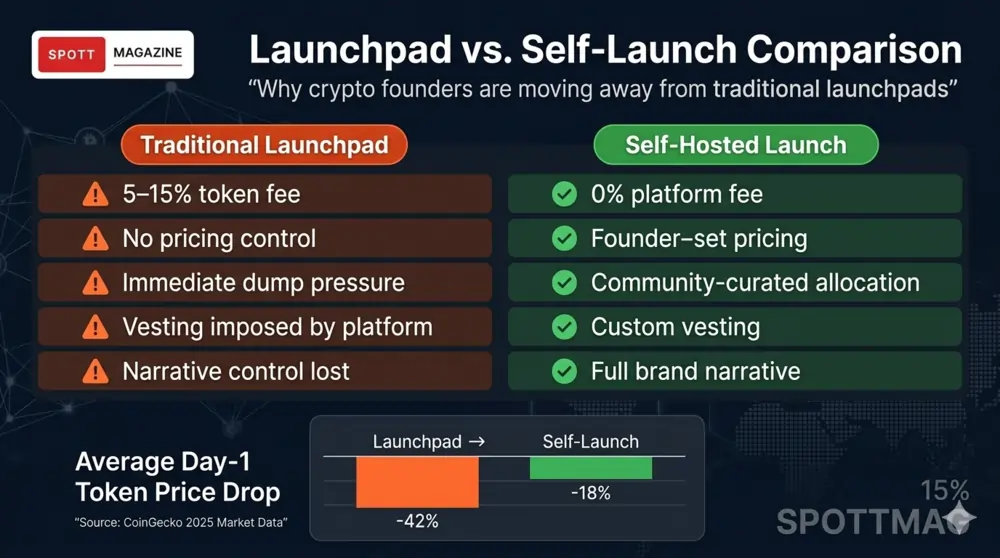
The economics of a traditional launchpad relationship have always been skewed against founders. Most platforms demand between 5% and 15% of token supply as a listing fee, in addition to requirements to allocate significant portions to the platform’s staking community. For a project with carefully balanced tokenomics, this can be catastrophic — diluting the founder’s vision before the first line of code ships to mainnet.
Beyond supply dilution, there are performance expectations. Launchpad audiences are trained to flip tokens within hours of a listing, creating instant sell pressure that punishes projects with long-term roadmaps. Founders building infrastructure protocols, DePIN networks, or AI-blockchain integrations find that the launchpad model is structurally misaligned with their five-year vision.
The Control Problem
Perhaps the deeper issue is governance. When a launchpad accepts a project, it also inherits influence — over listing timing, pricing structure, vesting schedules, and even post-launch communication. Founders who have been through the process describe a loss of narrative control that is difficult to recover from. The launchpad’s community becomes the project’s loudest voice, for better or worse.
“Access should be based on value and contribution, not how much capital you bring. We completely remove VCs and replace them with KOLs and builders.”
— Rosa Pagani, Co-founder of SeedList, 2025
The ETF Outflow Effect on Founder Confidence
The macro backdrop matters here. When Bitcoin ETFs saw over $1.72 billion in weekly outflows — the largest since February 2025 — the psychological impact on the broader crypto fundraising ecosystem was significant. Institutional hesitancy trickled down into retail sentiment, making launchpad participants more risk-averse and more likely to dump allocations at listing. This made the launchpad model even more toxic for serious founders trying to build long-term holder bases.
What Founders Are Choosing Instead
Self-Hosted Token Sales
Platforms like Echo by Cobie have made self-hosted, compliance-friendly token sales a viable alternative. Rather than submitting to a platform’s vetting process and tokenomics demands, founders can configure their own sale parameters — whitelist criteria, allocation caps, multi-stage vesting — and deploy directly to their communities. This preserves economic integrity while maintaining regulatory compliance through built-in KYC and AML tooling.
Community-First Distribution
A new generation of hybrid models is emerging that blends the community access of launchpads with the founder control of self-hosted sales. Kaito Capital Launchpad, launched by an ex-Citadel founder in July 2025, introduced social-reputation scoring and AI-driven analytics to allocate tokens based on genuine contribution — not just staking power. SeedList, meanwhile, uses AI to assess technical input and social reach, redistributing allocations to KOLs and builders rather than passive capital holders.
The Data: Launchpad Market at a Crossroads
| Model | Platform Fee | Founder Control | Avg. Day-1 Drop | Trend |
|---|---|---|---|---|
| Traditional IDO Launchpad | 5–15% tokens | Low | ~42% | Declining |
| Self-Hosted (Echo, Sonar) | 0–2% | Full | ~18% | Rising Fast |
| Community Hybrid (SeedList, Kaito) | 2–5% | High | ~24% | Emerging |
| VC-Backed OTC | Equity/SAFTs | Medium | ~55% | Under Pressure |
Is This the End — or a Reinvention?
The launchpad market is not dying outright. According to CoinGecko data, the aggregate launchpad sector exceeds $3 billion in market capitalization and is projected to grow at 19.6% CAGR to reach $6.22 billion by 2033. But the composition of that market is shifting dramatically. Platforms that offer pure capital without value-add are being disintermediated. Those that combine compliance, analytics, brand building, and community governance are thriving.
Conclusion: The Power Shift in Web3 Capital
The message from founders in 2026 is clear: the era of surrendering tokenomics control in exchange for launchpad exposure is over. In its place, a more sophisticated fundraising ecosystem is emerging — one where founders command their narrative, design their own distribution, and build genuine long-term communities. The launchpad is not dead. But it is being radically redefined — and the founders are holding the pen.
Key Takeaways
- Traditional launchpads charge 5–15% in token supply — a structural tax that punishes serious founders
- Bitcoin ETF outflows amplified retail sell pressure at token listings, making launchpad economics worse
- Self-hosted platforms (Echo, Sonar) now offer full founder control with compliance built in
- AI-powered hybrid models (Kaito, SeedList) are the fastest-growing alternative in 2025–26
- The launchpad market is growing — but redistributing toward models that serve founders, not just platforms
SpottMag > Business > Token Launchpads